
Language Learning Across Generations
Language Learning Across Generations and the Need to Learn English and Spanish Has Evolved Across Generations.
Learning a language is never just about vocabulary or grammar; it reflects the world each generation lives in. Every generational group develops under different social conditions, technological advances, and cultural changes that shape how they learn languages—and why they do it.
Below is an overview of how the need to learn English or Spanish has changed from the Silent Generation to Generation Alpha.
Listen » Podcast in Spanish
Listen » Podcast in English
PDF » Spanish
PDF » English
Learn » Vocabulary
Discussion Topic » Aprendizaje de Idiomas entre Generaciones
Language Learning Across Generations: From 1928 (Silent) to Present (Alpha)
1. Silent Generation (born approx. 1928–1945)
They grew up during and after World War II. Learning a foreign language was seen as a luxury.
In Spanish-speaking countries:
Learning English was limited to diplomats, academics, and people with access to elite education.
It was associated more with status and international opportunities.
In English-speaking countries:
- Spanish was seen as an academic interest, not a practical skill.
- Latin immigration was not yet as significant.
2. Baby Boomers (born approx. 1946–1964)
They began to see a more connected world.
In Spanish-speaking countries:
The importance of English grew due to the expansion of multinational corporations and tourism.
More schools included English, though quality varied.
In the U.S. and Canada:
Spanish started gaining visibility due to the growth of Latino communities and Latin culture.
However, formal language education was still limited.
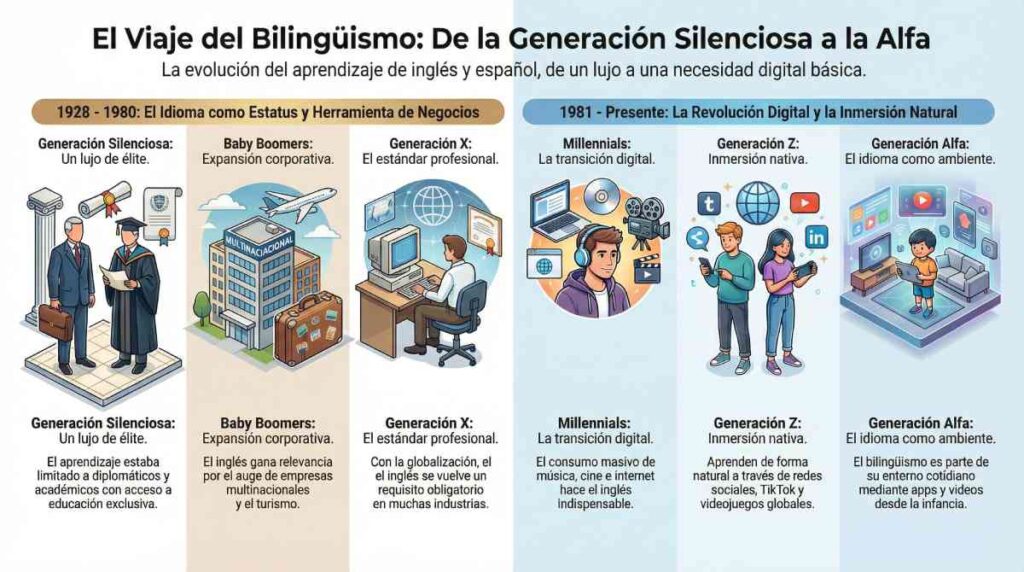
3. Generation X (born approx. 1965–1980)
They grew up with globalization, the rise of computers, and the expansion of international business.
English:
- Became a required professional standard.
Many industries started to demand it.
Spanish:
- Increased in popularity in the U.S. due to Latin immigration and cultural influence.
- Schools began offering Spanish more consistently.
4. Millennials (born approx. 1981–1996)
They represent the transition between the analog and digital worlds.
English:
- For Spanish speakers, it became almost essential in technology, science, commerce, and customer service.
- Massive consumption of English content accelerated learning: music, films, the internet, and video games.
Spanish:
- Gained strength in the U.S. due to the growth of the Latino population and its cultural influence.
- Began to be seen as a real economic advantage.
You may want:
Join Se Habla, a global community gathering for English and Spanish language exchange. Five years of learning and making friends from around the world.

Take the leap and learn the Spanish Language Online
5. Generation Z (born approx. 1997–2012)
The first fully digital generation.
English:
Learned naturally because the internet operates primarily in English.
Video games, social media, and global platforms facilitate immersion.
Spanish:
Latin music, TikTok, bilingual creators, and cultural blending increase interest.
In the U.S., it is the most bilingual generation in history.
6. Generation Alpha (born 2013–present)
The youngest generation, still growing.
English:
Learned from apps, videos, games, and schools from a very young age.
It is part of their environment, not just a school subject.
Spanish:
The second most spoken language in the world.
Its presence continues to grow in entertainment and education.
Conclusion: Language Learning Across Generations
In one century, Language Learning Across Generations has shifted from being a luxury, to an advantage, to practically a necessity in a globalized and digital world.