
he New Era of Space Exploration: NASA Moon Expedition Explained
The dream of walking on the lunar surface is no longer a memory from the 1960s. Today, the nasa moon expedition is a living reality, spearheaded by the ambitious Artemis program. As of April 2026, humanity has officially returned to the lunar neighborhood, marking the most significant leap in deep-space travel in over five decades.
This mission is not just a “repeat” of history. It is a sophisticated, multi-national effort to establish a permanent human presence on the Moon. By leveraging new technologies and international partnerships, NASA is proving that the Moon is the ultimate gateway to Mars and beyond.
In this guide, we will explore the specifics of the current mission, the technology driving it, and the complex reasons—scientific, economic, and political—why we are going back.
Listen NASA Moon Expedition 2026
What is Artemis II? The Current NASA Moon Expedition
The Artemis II mission is the cornerstone of modern nasa moon programs. Launched on April 1, 2026, it represents the first time humans have traveled to the Moon since the Apollo 17 mission in 1972.
Unlike its predecessor, Artemis I, which was an uncrewed test flight, Artemis II carries a crew of four brave astronauts. Their mission is a 10-day journey that tests the life-support systems of the Orion spacecraft while performing a lunar flyby.
Meet the Artemis II Crew
The mission is commanded by Reid Wiseman, joined by Victor Glover, Christina Hammock Koch, and Canadian Space Agency astronaut Jeremy Hansen. This diverse crew signifies a new chapter in international cooperation.
The Significance of the Artemis II Patch
If you look closely at the artemis ii patch, you will see a design that honors the past while looking forward. The patch features the Earth and Moon framed by the “Earthrise” perspective, symbolizing our shared home and our next destination. The triangular shape points toward the future, specifically emphasizing the path to Mars.
The Power Behind the Mission: The Artemis II Rocket
To send humans 230,000 miles away from Earth, NASA requires unprecedented power. This is provided by the artemis ii rocket, officially known as the Space Launch System (SLS).
The SLS is the most powerful rocket ever built. It provides the thrust necessary to propel the Orion capsule out of Earth’s orbit and toward the lunar flyby trajectory.
Height: 322 feet (taller than the Statue of Liberty).
Thrust: 8.8 million pounds at liftoff.
Payload: Capable of carrying crew and massive amounts of cargo for lunar base construction.
You may want:
Join Se Habla, a global community gathering for English and Spanish language exchange. Five years of learning and making friends from around the world.

Take the leap and learn Spanish & English Language Online
Why are we going back? The Real Reasons for Space Exploration
Many people ask: “Is it just about science?” While science is a primary driver, the reality of the nasa moon expedition is multifaceted. NASA isn’t just looking for moon rocks; they are building a lunar economy.
1. Scientific Discovery and Water Ice
The Moon’s South Pole contains “cold traps” where water ice has existed for billions of years. This isn’t just for drinking; water can be broken down into oxygen for breathing and hydrogen for rocket fuel. This makes the Moon a “gas station” in space.
2. Strategic Geopolitics: The Race for Preeminence
In the 21st century, being the “first country” to establish a presence is a matter of national security and international influence. With China planning its own lunar landings by 2030, the U.S. and its partners are racing to set the “rules of the road” for lunar activity.
3. Mining and Rare Minerals
The Moon is rich in resources that are rare on Earth:
Helium-3: A potential fuel for clean nuclear fusion energy.
Rare Earth Metals: Essential for modern electronics and green technology.
Regolith: Lunar soil that can be used for 3D-printing habitats.
4. Is it an “Escape” for the Rich?
While science fiction often suggests a “Plan B” for the wealthy if Earth is destroyed, the current reality is much more grounded. Space exploration is about protecting Earth by moving heavy industry off-planet and finding sustainable resources, rather than abandoning our home.
Comparing Apollo vs. Artemis
| Feature | Apollo Program (1960s-70s) | Artemis Program (Current) |
| Goal | Landing and returning | Sustainable presence & Base camp |
| Duration | Short stays (days) | Long-term missions (weeks/months) |
| Technology | Analog, single-use | Digital, reusable, and AI-integrated |
| Diversity | All-male crews | Diverse international crews |
| Destination | Lunar equator | Lunar South Pole |
The Future: From Artemis II to a Lunar Base
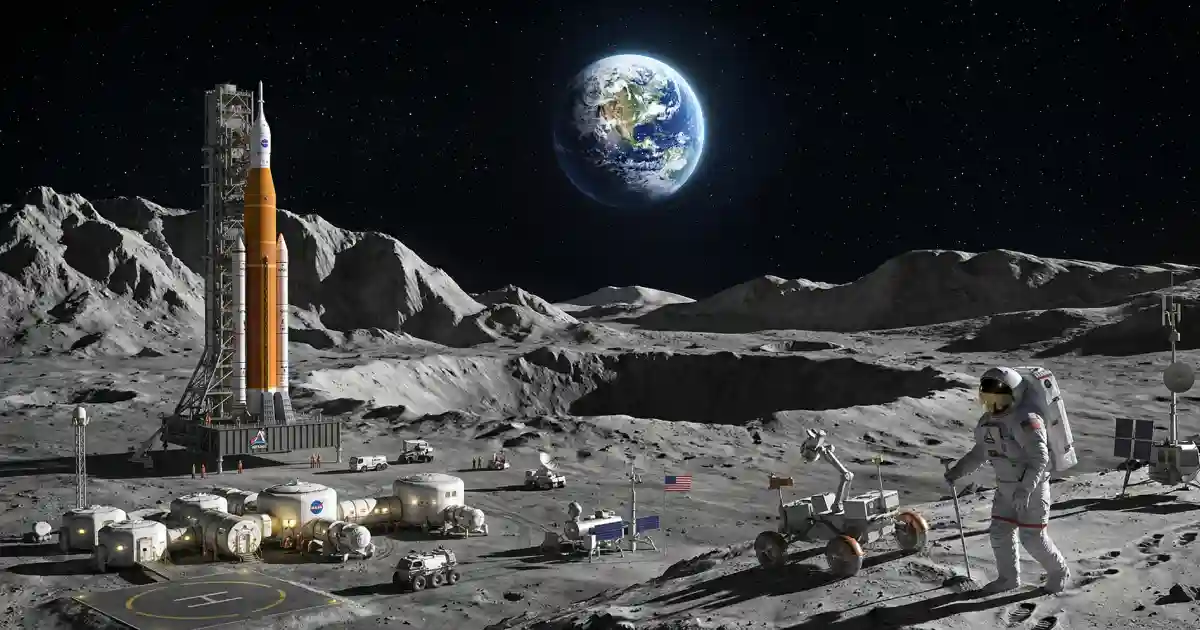
The success of Artemis II paves the way for Artemis III and IV, which will actually land humans on the surface. NASA’s long-term vision includes the “Base Camp” at the South Pole and a lunar-orbiting station.
This infrastructure is essential for the “Moon to Mars” strategy. By learning to live and work on the Moon—where a mistake is only three days from home—NASA prepares for the multi-year journey to the Red Planet.
Frequently Asked Questions (FAQ)
When did the latest nasa moon expedition launch?
The Artemis II mission launched on April 1, 2026, from the Kennedy Space Center in Florida.
Who is on the Artemis II crew?
The crew consists of Commander Reid Wiseman, Pilot Victor Glover, Mission Specialist Christina Hammock Koch, and Mission Specialist Jeremy Hansen.
Why is the Moon’s South Pole important?
The South Pole contains water ice in permanently shadowed craters. This ice is critical for creating life support and fuel for future deep-space missions.
How does the artemis ii rocket compare to the Saturn V?
The SLS (Artemis rocket) produces 15% more thrust than the Saturn V, making it the most powerful rocket currently in operation.
Conclusion: A Giant Leap for a New Generation
The nasa moon expedition is more than just a flight; it is a declaration of human potential. Through artemis ii and future nasa moon programs, we are not just visiting the Moon—we are staying. Whether it is for scientific breakthroughs, securing rare minerals, or preparing for the journey to Mars, the Moon is the essential first step.
The “Artemis Generation” is now. As the crew of Artemis II completes their journey, they carry the hopes of a planet looking upward.